THE CONDESA ARCHIVE
Persnickety Impeller Pumps
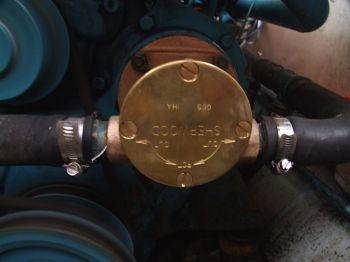
Essentially every marine engine has an impeller raw water pump. This pump sucks sea water through an intake, pushes and pulls it through various heat exchangers, then injects it into the exhaust, thus enabling a water-cooled exhaust made of flexible hose.
The first given about impeller pumps is that you must always carry a spare impeller. All it takes is a piece of flotsam clogging the intake for a few minutes, or someone forgetting to open an intake valve, and you’ll have a melted impeller, followed by the engine overheating from lack of raw water circulation:
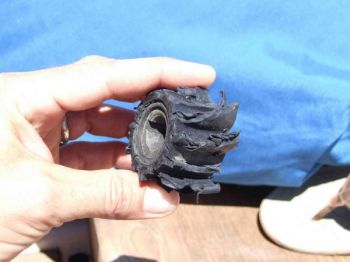
Impellers are pretty tough. They can run dry for 2-3 minutes before melting down, but melt down they will.
In prolonged degradation an impeller will lose individual vanes one by one. The vanes will end up stuck somewhere downstream and must be tracked down and removed (someday). Some say to replace an impeller every year, but they can go for several. At any rate, always carry a spare.
I’ve had a run of issues with impellers that are a little more subtle, and they all seem to stem from increasing the gap alongside them, that is, the gap between the cover plate and the side of the impeller.
This can come from wear of the cover plate. The plates are usually made of bronze, like the rest of the pump, and they wear over time. A common trick is to just flip the plate. Here are the two sides of the same plate, with varying levels of wear on both sides:
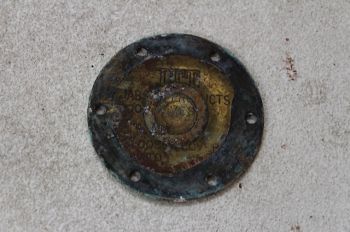
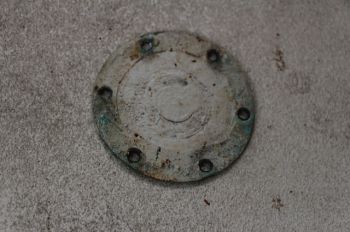
I had my engine stop spitting water, soon to overheat, about fifty miles off the Antarctic Peninsula, and after much troubleshooting and crawling around, all we needed to do was flip the plate. We’re talking fractions of a millimeter in material thickness here, but it’s enough to to screw up the dynamics in the impeller housing and make it stop pumping water.
A few weeks ago, on our cruise to the delta, the engine overheated repeatedly and I did much crawling around, troubleshooting, and burning myself. Since there’s so much flotsam in the delta I kept suspecting a clogged intake, and then concluded that whatever had been clogging the intake had dislodged itself once things started working again.
As it turns out, it was that pesky gap alongside the impeller again. This time it wasn’t from a worn cover plate, but because I’d used an o-ring instead of a gasket to seal the plate. Spare impellers usually come with an array of o-rings and gaskets:
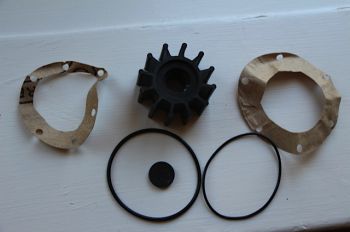
For some reason I thought I’d try an o-ring, when mine usually takes a gasket. It turns out that the o-ring added just enough thickness to screw up the works, or maybe it allowed the impeller to suck air under the plate. At 1200 RPM everything worked fine; at 1400 RPM she was sure to stop spitting water and overheat within minutes.
In short, for such hearty, fool-proof little pumps, they’re actually very sensitive - as in, micrometers sensitive - when it comes to this gap. We can assume that the back of the housing, the part the other side of the impeller rubs on, wears down just like the cover plate, but since we can’t futz with it without replacing the whole housing, the cover is the only place we have any control.
As to wear on the periphery of the pump - where the vanes rub - this doesn’t seem to make much difference. My impeller pump is nearly fifty years old, with about 14,000 hours on it, and it still works like a champ as long as the gap between the impeller and the cover plate is tight, but it took me a long time to zero in on this. The periphery of the bronze housing has to have worn down as least as much, if not more, than the cover plate, but performance is fine.
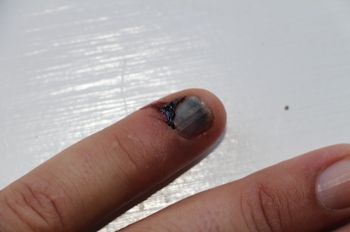
In an unrelated story, the last segment of the pinky finger, when smashed, conveys a disproportionate amount of pain for such a small and relatively unimportant body part: